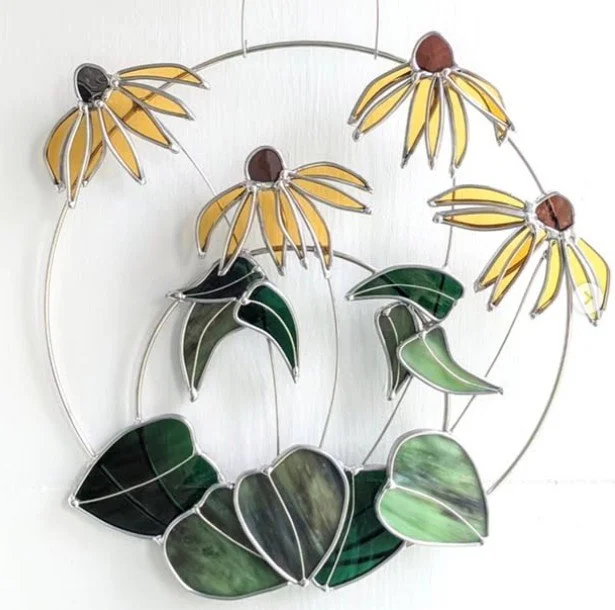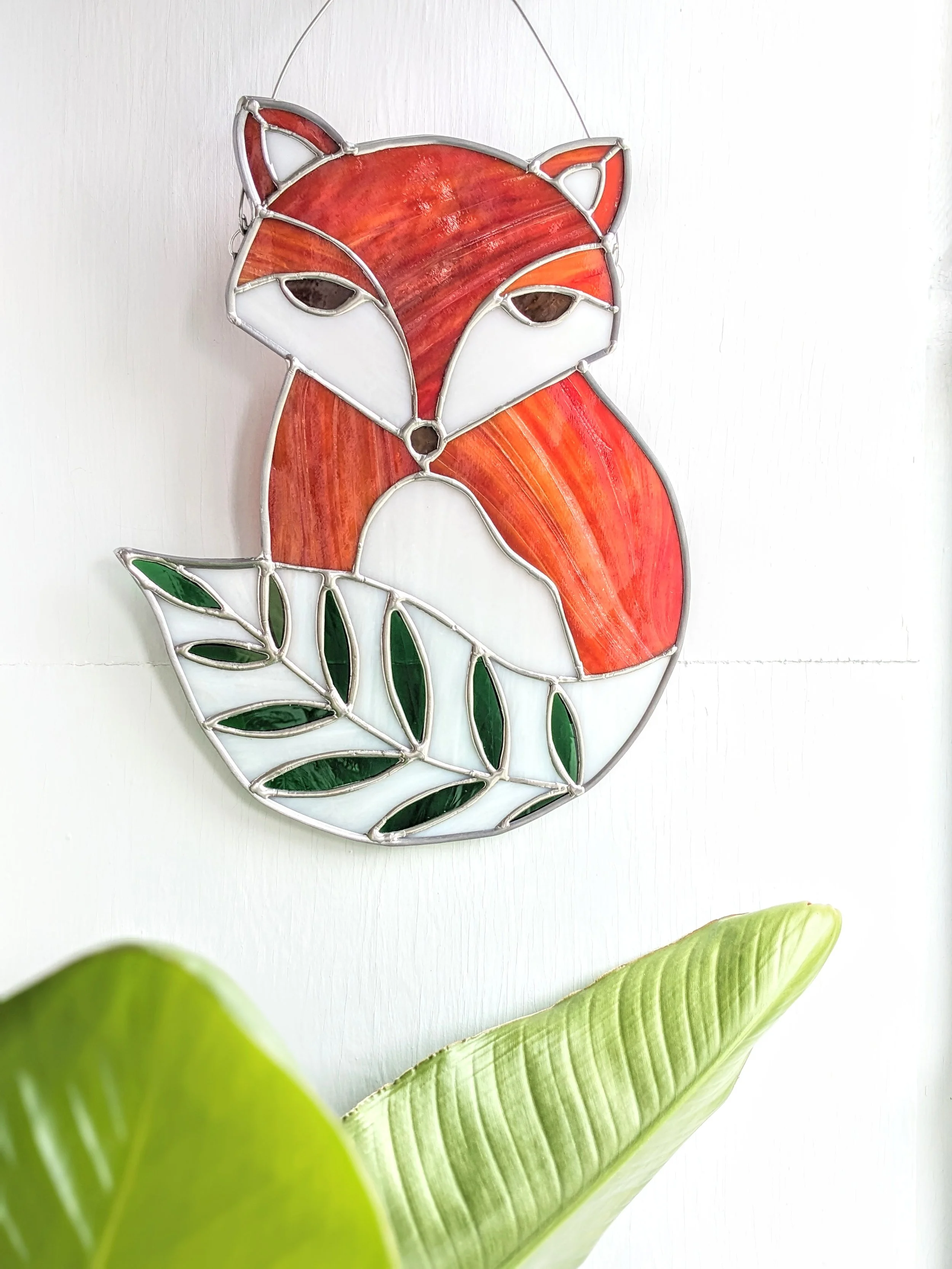


Caring for your glass art is easy
-
To clean both fused glass and stained glass art, wipe and buff gently with a dry microfiber cloth, taking great care around painted areas. You may dampen the cloth with water, if you wish. To polish your piece, you can use a small dab of liquid car wax on a microfiber towel to gently buff the glass, then wipe away with a clean microfiber cloth.
-
Solder, lead and zinc may darken over time. This is a natural part of oxidization and will not affect the structure. If you’d like to keep the silver solder, lead frame and/or zinc frame shiny, here’s how!
If your piece is not patinaed black or copper, you may buff the silver solder, lead and/or zinc frame with 0000 (very fine) steel wool. This typically does not scratch the glass, but test a small area to be sure. Finish by wiping with a dry microfiber cloth.
KEEP IN MIND
Using steel wool on black or copper patina takes off the patina, so should be avoided, unless you want the piece to have a silver finish instead of black or copper. Always wear a mask when buffing the lead and zinc solder and frames. And, wash your hands afterwards.
-
To hang your piece, avoid using suction cups as they are not a guarantee. Use hardware such as sturdy tea cup screws or nails, which can be installed into the wood frame of a window or into a wall.
Hang your piece with sturdy wire or chain. I like using 55# wire to hang my smaller pieces and heavier chain to hang the heavy pieces.
If using fishing line for small items like suncatchers, consider using something heavy like 30 pound line and replace it seasonally as fishing line eventually breaks down in the sun.
-
Most glass art is ok to display indoors or outdoors because it is made from the same type of glass that you see installed in buildings like synagogues and cathedrals.
If your piece contains a found object (like a shell, fabric, geode, agate, etc.), I would take great care when/if hanging it outside. The soldering process to seal found objects into the art is good but not perfect so the item may be susceptible to rain and other elements.
Even though glass would likely be just fine in extreme weather, I always suggest bringing your piece inside in these cases.
-
Stained glass art (and some fused glass art) is made with lead products, which is not harmful unless consumed or inhaled. It's a good idea to wash your hands after handling and keep out of reach of people sensitive to lead (like children) and pets.
-
Fused glass bowls, dishes and other types of home goods are not dishwasher, oven safe or microwave safe.
I know that may seem like a weird thing because the glass was fused at over 1,800 degrees in a kiln!
But, the science behind fusing glass together is a complicated thing. Glass is a poor conductor of heat, meaning that the entire piece has to heat AND cool (anneal) at the exact temperature across the entire piece, ALL OF THE TIME. Any quick difference in temperature means that the piece cracks or explodes. And, I don’t want you to do that to your oven, microwave or dishwasher!
Most fused glass homewares are likely fine to eat from but just to play it safe, I always recommend using the pieces as decor instead of for food.
As for stained glass - never eat or drink from stained glass art because it is soldered together with lead and lead is toxic if you eat or drink from it. See the above lead-based glass art info for more details.